
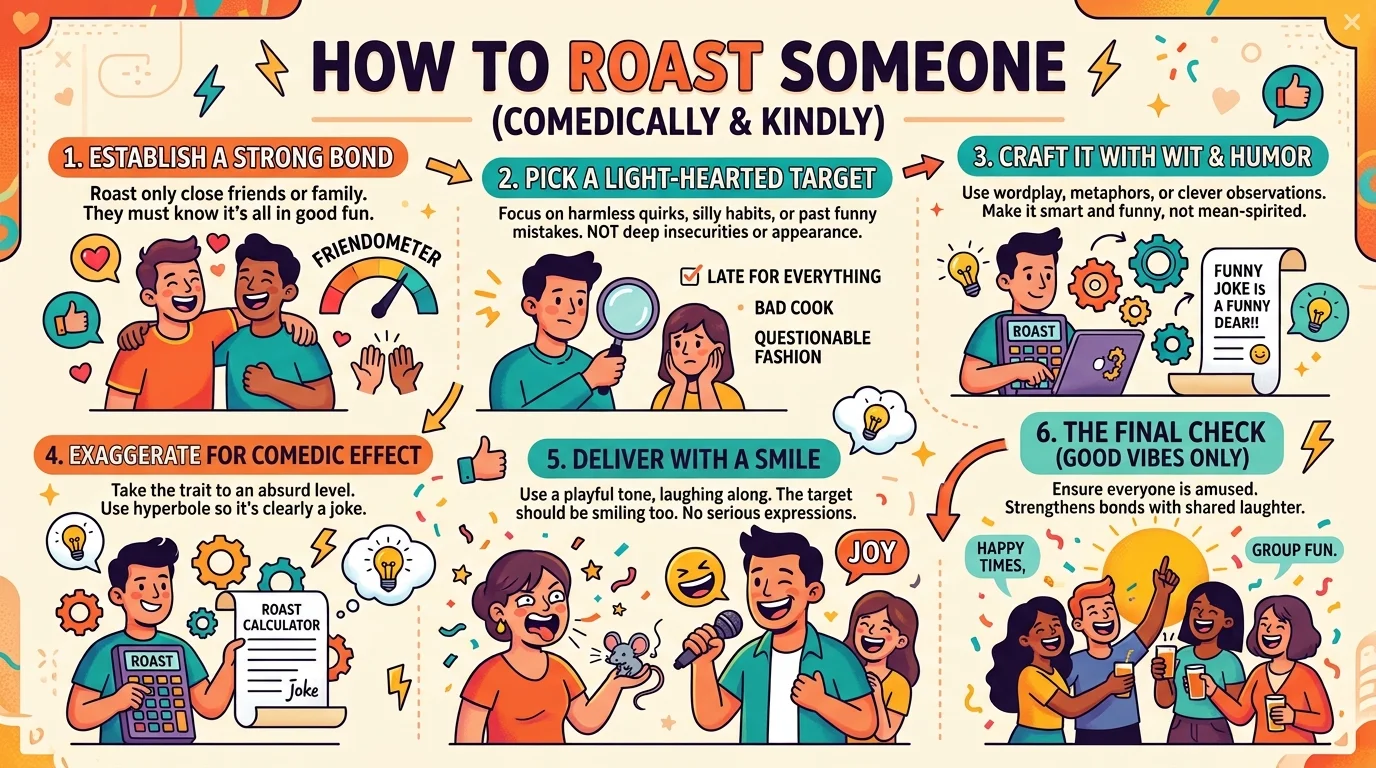
Have you ever watched a comedy roast or listened to friends teasing each other and wondered how they always come up with the perfect comeback? Learning how to roast someone isn’t about being rude or insulting. Instead, it’s about using clever humor, quick thinking, and playful exaggeration to make everyone laugh—including the person you’re roasting.
A great roast is witty rather than cruel. It points out harmless quirks, funny habits, or everyday situations in a way that feels entertaining instead of offensive. Whether you’re joking with friends, participating in a friendly roast battle, or simply improving your sense of humor, understanding the art of roasting can help you become funnier while maintaining healthy relationships.
This guide covers everything from the basics of roasting to techniques, examples, common mistakes, and the difference between playful teasing and bullying. for more explore:- letters to crushes and funny fat jokes.
What Does It Mean to Roast Someone?
Roasting someone means making humorous jokes about another person’s habits, personality, or behavior in a playful way. Unlike insults, roasts are intended to entertain rather than hurt someone’s feelings.
The concept became widely popular through celebrity roast events, comedy clubs, YouTube videos, TikTok trends, and social media banter. Today, roasting is common among close friends who understand each other’s sense of humor.
The key difference between a roast and an insult is intent. A roast aims to create laughter, while an insult is designed to offend or embarrass someone.
A successful roast is usually:
- Clever instead of cruel
- Creative instead of repetitive
- Funny instead of offensive
- Lighthearted instead of personal
When done correctly, everyone involved should be laughing by the end of the conversation.
Why People Enjoy Friendly Roasting
It Builds Stronger Friendships
Friends often tease each other because it creates a relaxed atmosphere. Lighthearted jokes can strengthen relationships when both people understand that no harm is intended.
Playful roasting also shows familiarity. The better you know someone, the easier it becomes to joke about harmless habits they recognize themselves.
However, trust is essential. Roasting someone you barely know can easily be misunderstood.
It Encourages Quick Thinking
Roast battles require creativity and confidence.
Instead of relying on rehearsed insults, experienced comedians and witty friends respond with original observations based on the situation.
This ability to think quickly often improves overall conversational skills and makes social interactions more engaging.
It Makes Conversations More Fun
Not every conversation needs to be serious.
A well-timed roast can lighten the mood, break awkward silence, and create memorable moments among friends.
The funniest roasts usually come from spontaneous observations rather than planned jokes.
How to Roast Someone Without Being Mean
Know Your Audience
The first rule of roasting is understanding who you’re talking to.
Close friends who enjoy playful teasing will usually appreciate a funny roast, while strangers or coworkers may not.
Before making a joke, ask yourself:
- Will they laugh?
- Are they comfortable with teasing?
- Have they joked with me before?
If the answer is no, it’s better to skip the roast altogether.
Roast Habits, Not Personal Traits
The funniest jokes usually focus on things people do rather than who they are.
For example, joking about someone’s habit of always arriving late is much safer than making fun of their appearance.
Good roast topics include:
- Always losing their keys
- Sleeping through alarms
- Spending too much time on their phone
- Forgetting simple things
- Taking forever to reply to messages
Avoid topics related to race, disability, body shape, mental health, family problems, or personal trauma.
Keep It Short
Long explanations ruin jokes.
Most memorable roasts are one or two sentences long.
The shorter the joke, the stronger the punchline.
Think of it like a comedian delivering a quick one-liner instead of telling a long story.
Techniques for Creating Funny Roasts
Use Exaggeration
Exaggeration makes ordinary situations hilarious.
Instead of saying your friend is slow, you might joke that they “could lose a race against a loading screen.”
The humor comes from taking a small truth and stretching it to an impossible level.
Compare Them to Something Unexpected
Unexpected comparisons create surprise, which is one of the foundations of comedy.
Examples include:
- “You’re like a software update. Everyone knows you’re important, but nobody wants you right now.”
- “You’re the human version of buffering.”
- “You remind me of Wi-Fi in a basement. Present, but not useful.”
The comparison should be silly rather than insulting.
Play With Everyday Situations
Many great roasts come from normal life.
If your friend always forgets things, jokes about sticky notes, reminders, or calendars can be surprisingly funny.
Relatable humor often works better than complicated punchlines.
The Best Qualities of a Great Roast
Creativity
Anyone can repeat internet insults.
Original jokes stand out because they feel personal without being offensive.
Observe funny habits and build your jokes around them.
Good Timing
Even the funniest roast can fail if delivered at the wrong moment.
Avoid roasting someone who is:
- Upset
- Angry
- Embarrassed
- Having a bad day
Comedy works best when everyone is already relaxed.
Confidence
A roast should sound playful rather than aggressive.
Smile while delivering the joke.
Your tone often determines whether people interpret your comment as friendly teasing or genuine hostility.
Funny Roast Examples
Here are a few lighthearted examples that rely on clever comparisons instead of personal attacks:
- “You’re like autocorrect. Somehow you’re always confident and still wrong.”
- “I’d explain it to you, but I left my crayons at home.”
- “You’re proof that even GPS can get lost.”
- “You have two speeds: slow and buffering.”
- “You’re the reason coffee needs a warning label.”
- “Your phone battery lasts longer than your attention span.”
- “You make Mondays look productive.”
- “You’re like a group project. Somehow everyone else ends up doing the work.”
- “I’ve seen loading bars move with more confidence.”
- “If overthinking burned calories, you’d be an athlete.”
These examples stay focused on humor instead of attacking someone’s identity.

How to Roast Different Types of People
How to Roast Your Best Friend
Your best friend is usually the easiest person to roast because you know each other’s personalities and boundaries. The funniest jokes often come from inside jokes, funny memories, or harmless habits that only the two of you understand.
Remember that a roast between best friends should strengthen the friendship, not damage it. If your friend laughs along and immediately fires back with a joke of their own, you’ve probably hit the right balance.
Here are a few playful examples:
- “You’re the only person who can get lost using Google Maps.”
- “Your phone has more screenshots than actual memories.”
- “If procrastination were a sport, you’d still sign up tomorrow.”
- “You’re the reason autocorrect needs therapy.”
- “You’re like a free trial—interesting for a while, then people move on.”
- “I’ve met goldfish with a better attention span.”
- “Your confidence is impressive considering your track record.”
- “You spend more time choosing a movie than watching it.”
- “You call it multitasking. I call it forgetting everything at once.”
- “Your room should qualify as an archaeological site.”
Keep your delivery playful, smile while speaking, and don’t continue roasting if your friend seems uncomfortable.
How to Roast Your Siblings
Brothers and sisters have been roasting each other since childhood. Friendly sibling rivalry often creates some of the funniest exchanges because you already know each other’s habits.
Focus on everyday situations instead of personal insecurities.
Some examples include:
- “You’re living proof that the Wi-Fi isn’t the only thing that disconnects.”
- “You act like you’re famous, but even the family dog ignores you.”
- “Your biggest workout is carrying snacks to the couch.”
- “I’ve seen turtles make decisions faster.”
- “You’re the family member everyone accidentally forgets to tag.”
The goal is to laugh together rather than turn the conversation into an argument.
How to Roast Classmates
School is full of funny moments, but it’s important to keep jokes respectful.
Never make fun of someone’s appearance, grades, or personal life. Instead, joke about harmless classroom situations everyone experiences.
Examples include:
- “You’re always raising your hand just to ask if homework is due.”
- “You bring a calculator to PE just in case.”
- “Your notebook has more doodles than notes.”
- “You treat every group project like a vacation.”
- “Your backpack carries everything except completed homework.”
These jokes are relatable because they focus on common student experiences rather than personal characteristics.
How to Roast Your Gaming Friends
Gamers constantly tease each other during online matches. Good gaming roasts focus on gameplay rather than attacking the person.
Funny examples include:
- “Your aim has trust issues.”
- “Even the tutorial gave up on you.”
- “The loading screen contributed more than you did.”
- “You respawn so often you should pay rent there.”
- “The bots are asking for easier opponents.”
Gaming banter is part of the fun, but remember that excessive trash talk can ruin the experience if someone isn’t enjoying it.
The Secret Formula Behind Every Great Roast
Most funny roasts follow a surprisingly simple structure.
Observation + Exaggeration + Unexpected Twist
For example:
Observation:
Your friend is always late.
Exaggeration:
They’re late to everything.
Twist:
“You’d be late to your own surprise party.”
Another example:
Observation:
Someone spends too much time on their phone.
Exaggeration:
They’re always scrolling.
Twist:
“If scrolling burned calories, you’d already have Olympic gold.”
This formula works because it transforms everyday behavior into something ridiculous and unexpected.
Common Mistakes People Make When Roasting
Going Too Far
Many people think harsher jokes are automatically funnier.
They’re not.
The funniest comedians know exactly where to stop.
If a joke targets someone’s biggest insecurity, it usually stops being funny.
Repeating Internet Insults
Copying viral insults from TikTok or Instagram quickly becomes boring.
Original observations are much more memorable.
Instead of repeating popular one-liners, pay attention to funny habits your friends actually have.
Ignoring Body Language
Watch how the other person reacts.
If they laugh, smile, or respond with another joke, the conversation is probably going well.
If they become quiet, embarrassed, or defensive, change the subject immediately.
Comedy should create smiles, not awkward silence.
Trying Too Hard
Some people constantly search for opportunities to roast everyone.
This usually becomes exhausting.
A perfectly timed joke is much more effective than nonstop teasing.
Sometimes saying nothing is the funniest choice.
When You Should NOT Roast Someone
Roasting isn’t appropriate in every situation.
Avoid joking when someone is:
- Feeling upset
- Having a stressful day
- Experiencing personal problems
- Angry or emotional
- Meeting you for the first time
- At work during professional conversations
- In a formal setting
Context matters.
A joke that’s hilarious among close friends might be completely inappropriate somewhere else.
How to Handle a Roast Gracefully
If someone playfully roasts you, don’t panic.
The best responses include:
- Laughing along
- Responding with another lighthearted joke
- Smiling and accepting the joke
- Complimenting a clever punchline
Taking yourself too seriously often makes the situation more awkward.
Confidence is one of the best responses to playful teasing.
Why Clever Humor Beats Mean Insults
Anyone can insult another person.
That doesn’t require creativity.
A clever roast, however, combines observation, timing, imagination, and confidence.
Great comedians rarely rely on cruelty alone.
Instead, they create jokes that surprise people without leaving lasting emotional damage.
That’s why memorable roasts are often quoted years later, while mean insults are quickly forgotten.
Frequently Asked Questions
Q: What is the best way to roast someone?
The best way to roast someone is with clever, playful humor rather than personal insults. Focus on harmless habits, funny situations, or exaggerated observations that make everyone laugh without hurting anyone’s feelings.
Q: What’s the difference between roasting and bullying?
Roasting is mutual, lighthearted teasing between people who understand the joke. Bullying involves repeated behavior intended to embarrass, intimidate, or emotionally harm another person.
Q: Are roasts supposed to be offensive?
No. Good roasts are funny because they’re creative, not because they’re cruel. The goal is shared laughter rather than humiliation.
Q: Can you roast someone you don’t know well?
It’s usually better not to. Roasting works best among friends who already understand each other’s personalities and boundaries. With strangers, jokes can easily be misunderstood.
Q: How do comedians come up with funny roasts?
Professional comedians observe everyday behaviors, exaggerate them, and add an unexpected twist. Timing, originality, and confidence are usually more important than harsh language.
Conclusion
Learning how to roast someone is really about mastering humor, not insults. The best roasts are clever, playful, and based on harmless observations that everyone can laugh about. Whether you’re joking with close friends, siblings, classmates, or gaming buddies, respect should always come before the punchline.
Remember that timing, creativity, and knowing your audience are the keys to successful roasting. A funny joke can strengthen friendships and create unforgettable memories, while a mean-spirited comment can damage relationships. When in doubt, keep your humor light, original, and good-natured.
The next time you join a friendly roast battle, focus on making people laugh—not making them feel bad. That’s what separates a truly great roast from an ordinary insult.